What BRSR and BRSR Core Actually Require
BRSR replaced the earlier Business Responsibility Report and is structured around the nine principles of the National Guidelines on Responsible Business Conduct (NGRBC). The report has three sections:
Section A – General disclosures (company overview, products, operations, employees, holding/subsidiary details, and reporting boundary).
Section B – Management and process disclosures (policies, governance, stakeholder engagement, and grievance mechanisms).
Section C – Principle-wise performance (essential indicators that are mandatory and leadership indicators that are voluntary but increasingly expected by sophisticated investors).
BRSR Core is a focused subset of key performance indicators under nine ESG attributes that must be independently checked. These typically cover greenhouse-gas emissions (including intensity metrics, often with PPP-adjusted revenue), energy consumption, water withdrawal and consumption, waste and circularity metrics, employee well-being and safety, gender diversity, inclusive development (including jobs in smaller towns and wages paid to women), fairness in dealings with customers and suppliers, and openness of business. Since the SEBI circular of 28 March 2025, companies may choose either reasonable assurance under recognised standards or a third-party “assessment” against standards developed by the Industry Standards Forum. Value-chain disclosures were also eased and are now voluntary for the top 250.
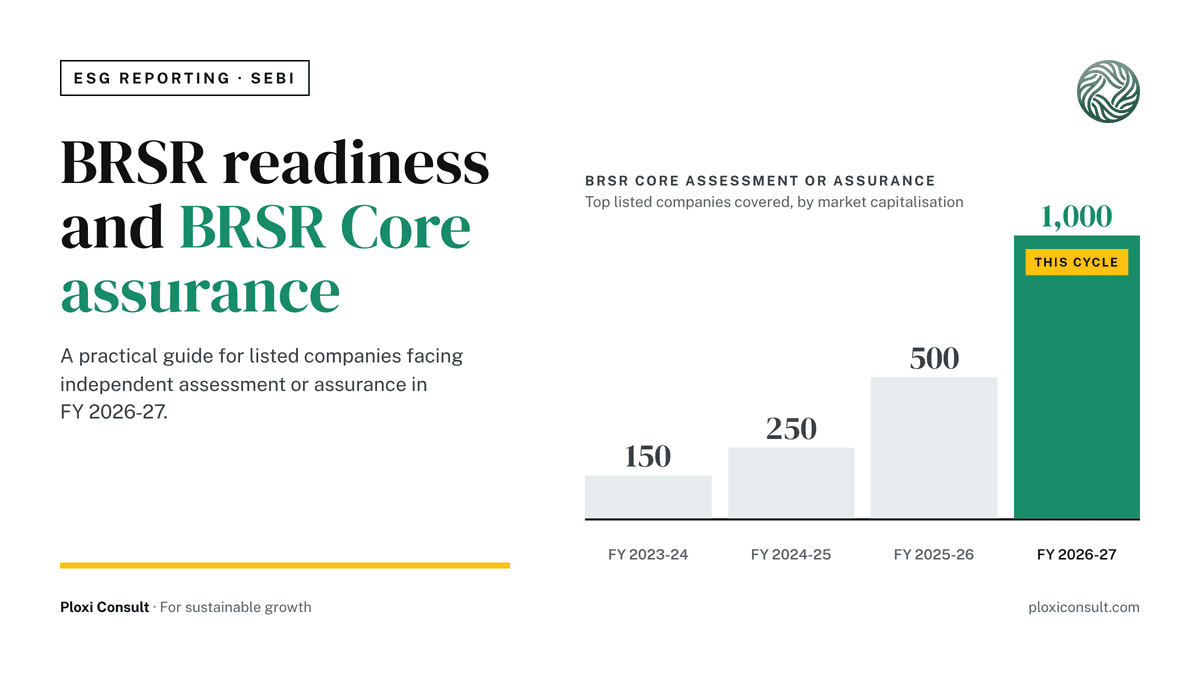
The glide path for BRSR Core assessment/assurance reached its final stage in FY 2026-27: top 150 (FY 2023-24), top 250 (FY 2024-25), top 500 (FY 2025-26), and now the full top 1,000. Rank is determined by market capitalisation as of 31 March of the preceding year, so companies near the boundary must monitor their position closely.
BRSR Core Assurance and Assessment Frameworks
The credibility of BRSR Core rests on independent verification. SEBI’s original July 2023 framework required reasonable assurance. The 28 March 2025 circular introduced flexibility by allowing listed entities to choose between two routes: assurance or assessment. Both routes require an independent third party, and the Board remains responsible for ensuring the provider has the necessary expertise and is free of conflicts of interest.
Assurance Route
This is a formal assurance engagement conducted under recognised standards for sustainability or non-financial information. Commonly accepted standards include:
• ISAE 3000 (Revised) – International Standard on Assurance Engagements (other than audits or reviews of historical financial information).
• ISSA 5000 – International Standard on Sustainability Assurance (designed specifically for sustainability information).
• ICAI’s SSAE 3000 – Standard on Sustainability Assurance Engagements.
• SAE 3410 – Standard on Assurance Engagements on Greenhouse Gas Statements (particularly relevant for emissions data).
Reasonable assurance (the higher bar originally mandated) involves extensive testing of source data, evaluation of internal controls, larger sample sizes, and a positive form of conclusion (“in our opinion, the information is fairly stated in all material respects”). Limited assurance is generally not sufficient for the mandatory BRSR Core attributes. The standard used must be disclosed in the report.
Assessment Route
Introduced to improve ease of doing business and make the process more profession-agnostic, assessment is a third-party review carried out strictly as per the standards developed by the Industry Standards Forum (ISF) in consultation with SEBI. The ISF comprises representatives from ASSOCHAM, CII and FICCI, working under the aegis of the stock exchanges. In December 2024, SEBI formalised the Industry Standards on Reporting of BRSR Core (applicable from FY 2024-25 onwards). These standards provide detailed guidance on data definitions, calculation methodologies (including intensity ratios and PPP adjustments), evidence expectations, and the approach for verification.
Assessment is not a lighter substitute; it still requires independent scrutiny of the nine Core attributes and supporting evidence. The key difference lies in the governing framework: assurance follows established international or ICAI assurance standards, while assessment follows the India-specific ISF standards.
Common Requirements for Both Routes
• The provider must be independent. It (and its network) cannot have conflicts of interest and generally cannot provide prohibited non-assurance or non-assessment services (such as consulting) to the listed entity or its group.
• The process is profession-agnostic: chartered accountants, company secretaries, cost accountants, and other suitably qualified firms may act as providers if they meet competence and independence criteria.
• The Board or Audit Committee must oversee selection and ensure the chosen provider has the requisite technical expertise in the relevant ESG domains.
• Clear documentation of the reporting boundary, methodologies, assumptions, and any restatements is essential under either route.
Companies should decide the preferred route early, evaluate providers against both technical competence and independence rules, and align internal data systems and evidence trails accordingly. Early engagement with the chosen provider significantly reduces the risk of qualifications or delays during the formal verification process.
Why Readiness Matters More Than Ever
Many organisations still rely on fragmented spreadsheets, plant-level estimates that cannot be reconciled, and last-minute data calls. When an assessor or assurer arrives, the common pain points surface quickly: inconsistent organisational boundaries, undocumented calculation methodologies, missing source evidence for intensity ratios, weak internal controls over non-financial data, and unclear ownership across EHS, HR, finance, and procurement. Prior-year restatements and boundary exclusions have already appeared in early assurance cycles; these erode credibility.
Strong readiness produces more than a clean report. It creates auditable data trails that support internal decision-making on energy efficiency, water stewardship, safety performance, and supply-chain risk. It also positions the company better for global frameworks (ISSB/IFRS S1-S2, GRI, TCFD-aligned climate disclosures) and for conversations with lenders and investors who increasingly scrutinise ESG data quality.
A Practical Path to BRSR Readiness
Effective preparation follows a disciplined sequence:
1. Confirm applicability and scope – Verify market-cap ranking, decide on assessment versus assurance, and lock the reporting boundary (equity share, operational control, or other) with clear documentation of inclusions and exclusions.
2. Map every Core KPI – Assign a named process owner, identify the source system or primary record, define the calculation methodology (including emission factors and intensity denominators), and list the exact evidence required. Intensity ratios must use a consistent, audited revenue figure and the appropriate PPP adjustment where specified.
3. Close data and control gaps – Implement or strengthen data collection at site and corporate levels, introduce review and approval workflows, and test reconciliations before year-end. Special attention is needed for multi-site operations, joint ventures, and leased assets.
4. Build the evidence file – Maintain a living repository of source data, calculation workbooks, policy documents, board minutes, and management representations so the external reviewer can work efficiently.
5. Conduct an internal readiness review – Simulate the assessment or assurance process several months ahead of filing. Identify residual gaps, correct them, and document residual limitations transparently.
6. Align governance – Ensure board or committee oversight of the BRSR process, clear escalation of material issues, and linkage to enterprise risk management.
Companies that complete these steps early reduce both the cost and the stress of external verification and produce higher-quality disclosures that stand up to scrutiny.
How Ploxi Consult Helps
Ploxi Consult is a Bengaluru-based sustainability and growth advisory firm that specialises in turning regulatory requirements into operational capability. We support listed companies and their value-chain partners with end-to-end BRSR readiness and reporting:
• Gap assessments against the latest BRSR and BRSR Core requirements (including post-March 2025 updates on assessment versus assurance).
• Guidance on selecting the appropriate verification route and evaluating provider independence and competence.
• KPI mapping, data-system design, and evidence-trail development aligned with both assurance standards and ISF assessment requirements.
• Calculation methodology documentation, intensity-ratio support, and PPP adjustments.
• Internal readiness reviews and pre-assurance/pre-assessment preparation.
• Full report drafting support, XBRL readiness coordination, and management presentation materials.
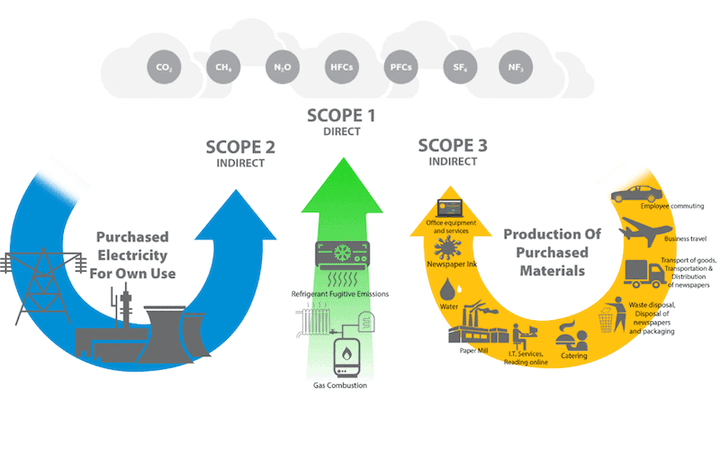
• Integration of BRSR data with broader net-zero strategy, Scope 1-3 inventories, and climate-finance positioning.
We combine deep technical knowledge of SEBI’s framework with practical experience in emerging-market operating environments. Our approach is collaborative: we work with your finance, sustainability, EHS, HR, and company-secretarial teams so that the systems we help build remain useful after the filing deadline.
The Opportunity Ahead
BRSR is no longer just a compliance filing. For companies in or approaching the top 1,000, it is a public demonstration of data integrity and responsible business conduct. Those that invest in robust readiness protect their reputation, reduce verification friction, and generate decision-useful insights. Those that delay face higher costs, greater risk of qualified findings, and missed opportunities to differentiate themselves with investors and customers.
If your organisation is preparing for BRSR Core assessment or assurance in the current cycle or wants to strengthen its overall sustainability reporting architecture; Ploxi Consult can help you move from reactive compliance to confident, repeatable reporting.
Reach out to discuss a tailored readiness roadmap.