Introduction
The European Union’s Carbon Border Adjustment Mechanism (CBAM) is no longer a policy on the horizon. It is fully operational. Since 1 January 2026, every tonne of covered goods imported into the EU has created a carbon-cost obligation for the importer. CBAM certificates go on sale on 1 February 2027, and the first annual CBAM declaration covering 2026 imports, together with the surrender of the matching certificates, is due by 30 September 2027.
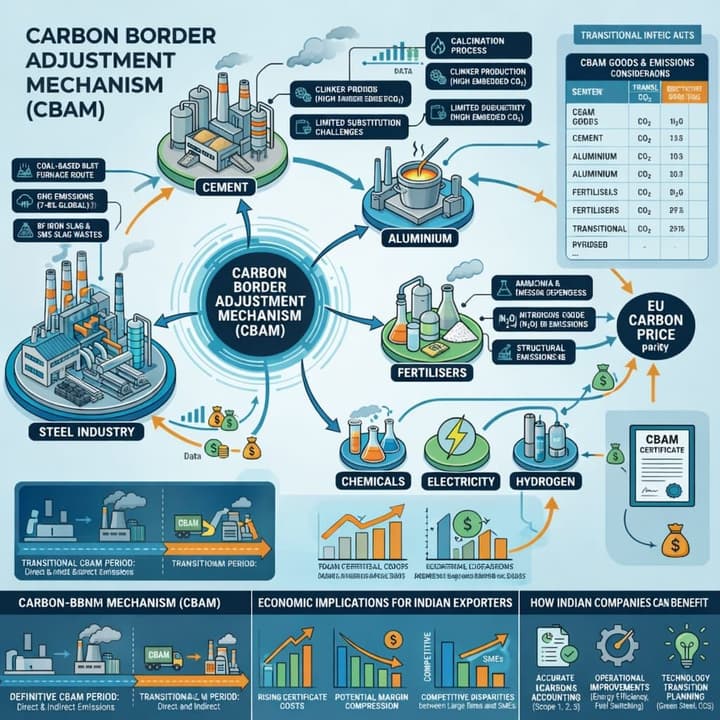
For Indian manufacturers and exporters of iron and steel, aluminium, cement, fertilisers, electricity and hydrogen, this is one of the most significant shifts in trade economics in a generation. CBAM is designed to equalise the carbon price paid by EU producers under the EU Emissions Trading System (EU ETS) with the carbon cost faced by imports. In practice, every tonne of CO₂ embedded in Indian goods exported to the EU now carries a real financial consequence. Either the European buyer pays it, or it is negotiated back onto the Indian exporter through lower prices, stricter data demands, or both.
The early market evidence is already visible. According to the Global Trade Research Initiative (GTRI), India’s steel and aluminium exports to the EU fell 24.4% in FY25 as buyers prepared for CBAM, with iron and steel down 35.1% to USD 3.05 billion. Buyers are requesting plant-level emissions data with increasing urgency. Where verified data is missing, default values with progressive mark-ups are applied. Companies that cannot demonstrate credible, lower actual emissions are losing commercial ground. Those that can prove their numbers and show a credible path to further reductions are strengthening their position as preferred suppliers.
This guide is written for Indian decision-makers: promoters, CFOs, sustainability heads, commercial directors and plant managers; who need a practical, actionable roadmap rather than high-level policy commentary.
It covers:
• the current rules;
• the commercial realities on the ground;
• the seven pillars of CBAM readiness;
• common pitfalls and cost implications;
• the link to India’s own carbon market;
• how specialised support can speed up the work while protecting margins.
Understanding CBAM in the definitive phase (2026 onwards)
During the transitional period (October 2023 to December 2025), importers reported embedded emissions every quarter, with no financial obligation. That phase is over.
The definitive regime introduces four core obligations for EU importers:
• Authorised CBAM declarant status, which is required to import more than the annual threshold of covered goods.
• An annual CBAM declaration of the embedded emissions in goods imported the previous year.
• Purchase and surrender of CBAM certificates that match those emissions, adjusted for the free allocation EU producers still receive.
• Independent verification of actual emissions data by an accredited verifier, wherever actual values are used instead of defaults.
What is covered. Covered sectors remain cement, iron and steel, aluminium, fertilisers, electricity and hydrogen. In December 2025 the European Commission proposed extending CBAM to around 180 steel- and aluminium-intensive downstream products from 1 January 2028. Exporters of fabricated metal goods should map their exposure now.
The threshold. A mass threshold of 50 tonnes of CBAM goods per importer per year applies. Electricity and hydrogen are outside the threshold.
Certificate prices. These track the EU ETS. For 2026 imports, the price is the quarterly average of EU ETS auction prices. From 2027 it moves to a weekly average.
Why the cost grows each year. The obligation rises steadily because free allocation for EU producers is being phased out. The CBAM adjustment covers 2.5% of embedded emissions in 2026, then rises step by step to 100% in 2034.
For non-EU producers, the critical practical point is this: the EU importer needs reliable data from you. If you cannot supply verified actual emissions, the importer must use default values. These are deliberately conservative. Under the Commission’s implementing rules, most defaults carry a mark-up of 10% in 2026, 20% in 2027 and 30% from 2028 (fertilisers follow a separate rule). Those higher costs flow straight back into commercial negotiations.
Estimate your exposure: try the free CBAM Cost Estimator on Ploxi Earth to see what your EU shipments could carry at current carbon prices.
Why Indian exporters face elevated CBAM exposure
India’s production mix in the key CBAM sectors is, on average, more carbon-intensive than EU benchmarks. Blast furnace–basic oxygen furnace (BF-BOF) steelmaking dominates, and grid electricity remains relatively carbon-heavy in many states. This creates a structural cost gap once CBAM certificates are fully priced in.
The commercial impact appears in several forms:
• price pressure from EU buyers seeking to offset their certificate costs;
• preference for suppliers who can provide clean, verified data packages;
• volume shifts toward lower-carbon origins, or toward markets without equivalent carbon border measures;
• growing requests for long-term emission-reduction commitments as part of offtake discussions.
At the same time, CBAM creates a powerful internal business case for decarbonisation. Every tonne of CO₂ reduced at the Indian plant lowers the certificate burden the EU customer must manage. Cleaner production therefore becomes a direct commercial advantage rather than a pure cost centre.
The seven pillars of practical CBAM readiness
Pillar 1 – Precise scope and product mapping
Map every relevant CN code, every production installation, every intermediate product and every export destination. Many companies discover that secondary or downstream items they considered out of scope are in fact covered, or soon will be, given the proposed 2028 extension. Treat this mapping as a living document and review it every quarter as rules and product lists evolve.
Pillar 2 – High-quality emissions measurement and data systems
Move from estimates and industry averages to installation-specific and product-specific data.
This requires:
• robust monitoring plans;
• accurate activity data;
• appropriate emission factors;
• clear allocation rules for multi-product facilities.
Data must be granular enough to support both CBAM reporting and internal decisions on process improvement. The same data discipline underpins wider value-chain reporting. See our guide to Scope 3 emissions assessment.
Pillar 3 – Verification readiness
Claims of actual emissions require independent verification by an accredited verifier, and verification capacity is finite. Companies that wait until late 2026 or early 2027 will face longer lead times and higher costs. Before the first declaration cycle, you should:
• engage verifiers early;
• prepare your monitoring plans;
• run internal readiness assessments.
Pillar 4 – Importer-ready data packages
Create standardised, clear emissions reports and verification summaries that European customers can use directly in their CBAM declarations. Treat this data package as a commercial product. Train sales teams to present it confidently as evidence of reliability and improving performance. That turns a compliance requirement into a sales differentiator.
Pillar 5 – Contractual and commercial safeguards
Review and update sales contracts.
Be clear on who is responsible for:
• data provision;
• verification costs;
• timelines for information exchange;
• any residual CBAM costs.
Ambiguity here creates future disputes and weakens your negotiating position with EU buyers, who are themselves under regulatory pressure.
Pillar 6 – Integrated decarbonisation roadmap
Identify the highest-impact, commercially viable levers:
• energy efficiency and process optimisation;
• fuel switching;
• increased scrap use;
• renewable power procurement (including I-RECs or direct PPAs);
• longer-term technology transitions.
Check which emissions CBAM actually counts for your product. Indirect emissions from electricity are included for cement and fertilisers, but currently not for iron and steel, aluminium or hydrogen. So renewable power cuts CBAM cost directly for some sectors, and future-proofs the others.
Quantify the CBAM cost savings for each lever, so that investment decisions rest on clear financial returns rather than abstract sustainability goals.
Pillar 7 – Scenario planning, carbon markets and finance alignment
Model your exposure under different carbon-price and free-allocation trajectories.
Explore how India’s Carbon Credit Trading Scheme (CCTS) may interact with CBAM. The Government has notified greenhouse gas emission-intensity targets for aluminium, cement, chlor-alkali and pulp and paper (October 2025), and for refineries, petrochemicals, textiles and secondary aluminium (January 2026). CBAM allows a carbon price effectively paid in the country of origin to be deducted, subject to EU implementing rules, so how the CCTS is designed matters to exporters. Read more in India’s carbon market just changed.
Finally, structure access to climate finance, green loans or carbon-linked instruments. These can fund the transition while protecting cash flow and strengthening the overall business case.
Common CBAM pitfalls that are already costing companies money
• Treating CBAM as a compliance or sustainability-team issue alone, rather than a commercial and operational priority involving finance, sales and plant leadership.
• Relying on default values because “verification seems expensive”. The long-term cost of defaults is almost always higher once certificate prices and mark-ups are factored in.
• Delaying upgrades to measurement systems until after the first declaration cycle, when data gaps become expensive and difficult to close after the fact.
• Failing to align sales, procurement, operations and sustainability around a single, consistent set of emissions numbers.
• Ignoring the link between CBAM data quality and wider reporting, including BRSR disclosures, SBTi targets and customer due-diligence questionnaires.
• Underestimating the time required to gather historical data, prepare monitoring plans and complete verification before key deadlines.
CBAM cost implications and the business case for action
The exact cost depends on five things:
• the product;
• the production route;
• actual versus default emissions intensity;
• the prevailing certificate price;
• the free-allocation adjustment.
For many Indian steel exporters, the difference can run to tens of euros per tonne once full pricing is in effect. Across meaningful export volumes, this quickly becomes material to margins and competitiveness.
The countervailing business case is equally clear. Companies that invest early in measurement integrity and emission reductions:
• avoid the most punitive default values and mark-ups;
• strengthen their position in price negotiations with EU buyers;
• become preferred suppliers for European customers under pressure to decarbonise their supply chains;
• improve access to climate-aligned capital, green loans and product premiums;
• build internal capability that also supports participation in India’s carbon market and wider net-zero goals.
How Ploxi Consult supports end-to-end CBAM readiness
Ploxi Consult is a sustainability and growth advisory firm based in Bengaluru, focused on accelerating clean transitions across emerging markets. We work with manufacturers, industrial groups, clean-tech innovators and investors, combining a deep technical understanding of emissions accounting and decarbonisation with commercial and financial pragmatism.
Our CBAM support typically includes:
• CBAM exposure diagnostics covering products, installations and data gaps;
• design and implementation support for monitoring, reporting and verification (MRV) systems aligned with CBAM methodologies;
• coordination and readiness support for independent verification;
• practical decarbonisation roadmaps that quantify both emission reductions and CBAM cost savings;
• carbon markets strategy, including the interface between the CCTS, international credits and CBAM;
• commercial playbooks and training for sales and negotiation teams dealing with EU buyers;
• climate finance structuring and investor matchmaking for transition projects;
• ongoing alignment with BRSR, the GHG Protocol, SBTi and related reporting frameworks;
• access to the Ploxi Earth platform for clean-tech solutions, carbon market tools, climate finance pathways and net-zero tracking.
We do not offer generic advice. We work alongside internal teams to deliver measurable readiness and commercial outcomes that protect margins and strengthen market position.
CBAM timeline: what should happen between now and September 2027
Immediate (Q4 2026)
• Complete product and installation mapping.
• Commission or upgrade emissions data systems.
• Engage potential verifiers.
• Confirm that your key EU customers hold, or have applied for, authorised CBAM declarant status.
• Begin commercial discussions with those customers about data requirements and expectations.
First half of 2027
• From 1 February 2027, EU importers can buy CBAM certificates. Expect buyers to firm up their data and price requests.
• Finalise monitoring plans.
• Complete initial verification cycles for priority installations.
• Prepare standardised data packages for customers.
• Update key commercial contracts.
• Launch priority decarbonisation projects with clear CBAM payback periods.
By 30 September 2027
• Ensure all required data and verification reports are available for the first declaration covering 2026 imports.
• Have a clear internal view of residual exposure.
• Have the next phase of emission reductions already under way.
Frequently asked questions (FAQs) about CBAM
1. Does CBAM apply only to direct exports from India to the EU?
No. It applies to covered goods imported into the EU, whatever the commercial chain. If your product ultimately enters the EU under a covered CN code, the importer will need the relevant emissions data from you.
2. When can CBAM certificates be bought?
Certificate sales open on 1 February 2027. Certificates for 2026 imports, together with the first annual declaration, must be surrendered by 30 September 2027.
3. What happens if we cannot provide verified emissions data?
Your EU importer must use the Commission’s default values, which include a mark-up of 10% in 2026, rising to 20% in 2027 and 30% from 2028 for most goods. That usually means a higher cost than your actual emissions would justify.
4. Can carbon prices already paid in India be deducted?
The CBAM Regulation allows a carbon price effectively paid in the country of origin to be deducted, subject to strict conditions and implementing rules. Whether it applies in practice will depend on the design of India’s CCTS and how the EU recognises it.
5. What about indirect emissions?
Rules differ by sector. Cement and fertilisers include certain indirect emissions. Iron and steel, aluminium and hydrogen currently cover direct emissions only. Always check the latest implementing acts for your specific product.
6. Is the UK CBAM the same?
No. The UK is introducing its own CBAM from 1 January 2027, with similar but not identical design features. Companies exporting to both markets need to track both regimes.
Turning CBAM compliance into growth
CBAM is accelerating a global re-pricing of carbon in trade. For Indian industry this creates both pressure and opportunity. The pressure is immediate and financial. The opportunity lies in using the same data systems, process improvements and technology investments to become a lower-carbon, higher-reliability supplier. That applies not only to Europe but to any market that increasingly values verified climate performance.
Companies that treat CBAM as a narrow compliance exercise will minimise short-term costs but may give up longer-term positioning. Companies that treat it as a catalyst for operational excellence, data integrity and strategic decarbonisation will protect margins, deepen customer relationships and improve their access to capital.
Start your CBAM readiness assessment
The definitive phase of CBAM is live. The window to build robust systems, secure verification capacity and demonstrate progress before the first declaration deadline is open, but it is not unlimited.
- Estimate your exposure with the free CBAM Cost Estimator on Ploxi Earth.
- Request a confidential CBAM exposure diagnostic: email sustainability@ploxiconsult.com or contact@ploxiconsult.com.
- Register your interest in our CBAM readiness workshops at ploxiconsult.com.
The rules of industrial competitiveness are being rewritten around carbon. The organisations that act with clarity and speed in 2026 and 2027 will define their position for the decade ahead.
**Sources** https://eur-lex.europa.eu/eli/reg/2023/956/oj https://taxation-customs.ec.europa.eu/carbon-border-adjustment-mechanism_en https://icapcarbonaction.com/en/news/eu-cbam-enters-compliance-phase-and-outlines-path-ahead https://icapcarbonaction.com/en/news/india-notifies-emission-intensity-targets-nine-sectors-under-carbon-credit-trading-scheme https://www.alcircle.com/news/indian-steel-and-aluminium-exports-to-eu-plunge-24-4-per-cent-ahead-of-cbam-rollout-gtri-reports-115600 Image Sources: https://www.investni.com/media-centre/features/what-cbam-and-how-does-it-affect-northern-ireland-businesses