A Scope 3 emissions assessment measures the greenhouse gases a company’s value chain causes, from what it buys to what happens to what it sells. It is usually the largest and least certain part of a carbon footprint, and the rules for it are being rewritten.
Somewhere in the working drafts of that rewrite is an example about paper clips. The GHG Protocol’s March 2026 progress update says: “An example of de minimis emissions could be the scope 3 category 1 emissions attributable to paper clips and staples used by a reporting company.” It is a modest example in a modest-looking document, and it holds the central argument of Scope 3 accounting. How small is small enough to omit? Who decides? And what has to be counted first to prove it?
The 2011 standard answers with a rule that carries no number: a company accounts for all Scope 3 emissions and discloses and justifies any exclusions. The 31 March 2026 progress update proposes a number. At least 95% of required emissions would have to sit inside the inventory, and the remaining 5% would itself have to be quantified.
This article follows that thread through the rest of the subject:
• what is measured, and why the figure is large;
• how an assessment is built;
• what the rewrite changes;
• which regulators and programmes are pulling on the result.
Every factual claim traces to a public source listed at the end.
A caution on status: the GHG Protocol material cited here is a progress update, not a standard. Its authors state that all content is draft and subject to change. Read every “proposed” in this article with that in mind.
1. What a Scope 3 emissions assessment measures
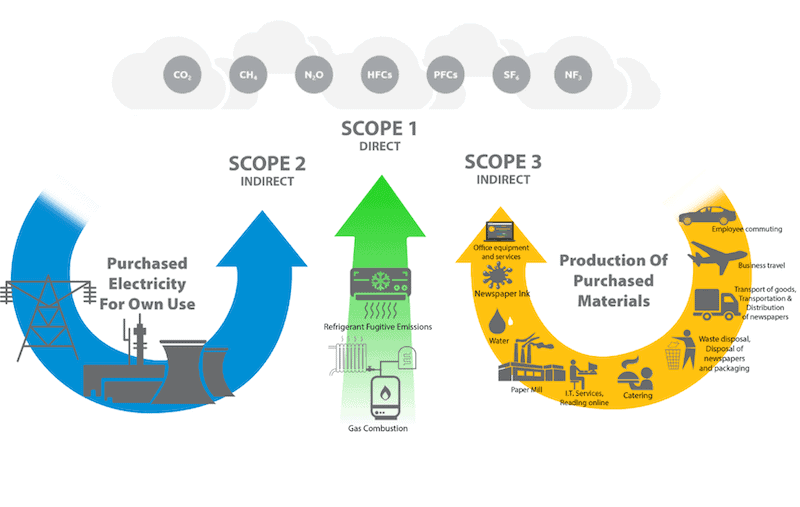
• Scope 1 covers direct emissions from sources a company owns or controls.
• Scope 2 covers emissions from purchased electricity, heat and steam.
• Scope 3 is everything else that a company’s activities cause along its value chain.
The GHG Protocol’s Corporate Value Chain (Scope 3) Accounting and Reporting Standard, published in 2011, sorts Scope 3 into 15 categories: eight upstream and seven downstream.
Inside one company’s inventory, the categories are designed so that each tonne lands in exactly one of them. Between companies the reverse holds: one firm’s downstream emissions are another firm’s upstream emissions. A steel mill’s furnace is the mill’s Scope 1 and its customer’s Category 1. Both ledgers are correct. This matters for anyone who adds Scope 3 figures across firms, as section 8 explains.
| # | Scope 3 category | Side |
| 1 | Purchased goods and services | Upstream |
| 2 | Capital goods | Upstream |
| 3 | Fuel- and energy-related activities not in Scope 1 or 2 | Upstream |
| 4 | Upstream transportation and distribution | Upstream |
| 5 | Waste generated in operations | Upstream |
| 6 | Business travel | Upstream |
| 7 | Employee commuting | Upstream |
| 8 | Upstream leased assets | Upstream |
| 9 | Downstream transportation and distribution | Downstream |
| 10 | Processing of sold products | Downstream |
| 11 | Use of sold products | Downstream |
| 12 | End-of-life treatment of sold products | Downstream |
| 13 | Downstream leased assets | Downstream |
| 14 | Franchises | Downstream |
| 15 | Investments | Downstream |
2. Why Scope 3 emissions are large, and why few firms report them
CDP’s June 2024 analysis of 2023 disclosures found that supply-chain Scope 3 emissions ran, on average, 26 times higher than Scope 1 and 2 combined. If a typical company followed that ratio, Scope 3 would be 26 of every 27 tonnes, or about 96.3% of its combined footprint. Treat that percentage as indicative, because an average of ratios is pulled upwards by firms with very large ratios.
The same analysis found that companies were twice as likely to measure Scope 1 and 2 as Scope 3, and that only 15% had set a supply-chain emissions target.
Targets give the ratio a second meaning. Under the SBTi Corporate Net-Zero Standard (version 1.3.1), Scope 3 must be included in near-term targets when it makes up 40% or more of total Scope 1, 2 and 3 emissions. Rearranged, the test reads S3 ≥ (40/60) × (S1 + S2). Scope 3 only has to reach about two-thirds of Scope 1 and 2 combined to trigger it, so a company at CDP’s average ratio of 26 clears the test many times over. Near-term targets must cover at least 67% of Scope 3, and long-term net-zero targets at least 90%.
Scope 3 reporting in India: the BRSR gap
India offers a close view of the disclosure gap. IIM Bangalore’s analysis of FY 2024–25 Business Responsibility and Sustainability Report (BRSR) filings by top listed companies covered 982 companies with valid filings across 22 sectors:
• 421 (42.9%) reported Scope 3 emissions, up from 292 (29.7%) the year before. That is a 44.2% rise in the number of reporters.
• The other 561 (57.1%) reported none.
In BRSR, Scope 1 and 2 sit among the Essential Indicators under Principle 6, while Scope 3 is a Leadership Indicator that a company may answer voluntarily.
The 421 reporting companies disclosed a combined 1.48 billion tCO₂e of Scope 3. The whole sample’s Scope 1 and 2 total was 1.31 billion tCO₂e, of which the power sector alone contributed 572 million (43.8%).
The two totals are not like-for-like. Fewer than half the companies supplied a Scope 3 figure, and the study records every figure as reported, without verification. Even so, Scope 3 reported by fewer than half the sample already exceeds the whole sample’s Scope 1 and 2.
3. How to build a Scope 3 emissions assessment, step by step
The standard rests on five accounting principles: relevance, completeness, consistency, transparency and accuracy. A workable assessment follows the sequence of the standard’s chapters on identifying emissions, setting the boundary, collecting data, allocating emissions and reporting:
1. Define what the inventory is for: target-setting, disclosure, supplier engagement or risk.
2. Map the value chain and screen all 15 categories with rough estimates. The 2011 standard calls this initial estimation. The draft revision calls it hotspot analysis: a high-level quantification of relative magnitude.
3. Set the boundary and record every exclusion with its reason.
4. Collect data, choosing specific data where it changes the answer.
5. Calculate and allocate, documenting the method, emission factors and global warming potential (GWP) source for each category.
Report by category, and arrange assurance where it is required.
Scope 3 calculation methods
The GHG Protocol’s technical guidance describes four calculation methods for purchased goods and services, and the same logic carries into other categories. Two need data from suppliers. The other two use secondary data.
| Method | What goes in | Data type |
| Supplier-specific | Product-level cradle-to-gate emissions from the supplier | Primary |
| Hybrid | Supplier data where available, secondary data to fill gaps | Mixed |
| Average-data | Physical quantity bought (for example mass) × an average emission factor | Secondary |
| Spend-based | Economic value of purchases × an emission factor per unit of spend | Secondary |
Methods can be mixed across categories, and across suppliers within one category. A common arrangement uses supplier-specific or hybrid data for the largest suppliers, and average-data or spend-based lines for the long tail. Product-level supplier data often comes from a life cycle assessment.
More specific data does not automatically mean more accurate data. The guidance notes that a supplier’s figure can represent the purchased product less well than an industry average for that product.
When suppliers provide data at facility or corporate level, it has to be allocated to the product bought. The standard ranks data levels from most to least specific:
1. product-level
2. activity or production line
3. facility
4. business unit
5. corporate level
Spend-based estimates also move with prices. If air fares rise while the distance flown stays the same, a spend-based figure for business travel rises with them.
4. The proposed 95/5 boundary rule, worked through
Current rule (2011 standard). Account for all Scope 3 emissions, and disclose and justify any exclusion. No threshold is set. Each category also has a minimum boundary, which the draft renames “required” emissions.
Proposed rule (Revisions B1 to B7 in the March 2026 update):
• The 95% floor: report at least 95% of total required Scope 3 emissions.
• Quantify everything every year: quantify all required emissions annually to prove the exclusions stay inside the 5%, using any method, hotspot analysis included.
• One exclusion budget: count de minimis exclusions inside the same 5%. The draft states: “The cumulative total of de minimis and non-de minimis exclusions shall not exceed the 5% exclusion threshold for scope 3 emissions.”
• Standard notation: mark exclusions as “NA” where no emissions are expected, or “X” where a category is excluded under the threshold.
• Separate reporting: report required and optional emissions separately.
• Intermediate-product exclusion stays: the existing exclusion for downstream emissions of intermediate products with unknown end use (Categories 9 to 12) remains, outside the 5%.
The Technical Working Group (TWG) supported the 95% rule by 87%. The draft says the 5% figure aligns with SBTi boundary requirements and mirrors CDP’s rule of thumb.
A worked example (invented numbers). Take a hypothetical manufacturer whose required Scope 3 emissions total 100,000 tCO₂e:
| Category | tCO₂e | Share |
| 61,000 | 61.0% |
| 9,000 | 9.0% |
| 4,500 | 4.5% |
| 10,500 | 10.5% |
| 2,000 | 2.0% |
| 700 | 0.7% |
| 1,100 | 1.1% |
| 400 | 0.4% |
| 6,000 | 6.0% |
| 4,800 | 4.8% |
| Total | 100,000 | 100.0% |
The exclusion budget is 5%, or 5,000 tCO₂e.
With that budget:
• Categories 5 to 8 together come to 4.2%, so they fit.
• Category 12 alone, at 4.8%, also fits.
• The two together make 9.0%, so they do not.
• Category 3, at 4.5%, fits only if nothing else is dropped.
The budget is a single pool for the whole inventory, and it can only be spent once. The company also learns the size of each line only because it estimated all 100,000 tonnes first. That rough estimate of everything is the practical cost of the rule. (For simplicity, all lines here are treated as required emissions.)
5. The GHG Protocol Scope 3 revision: a standard in motion
Timeline:
• 9 September 2025: the GHG Protocol and ISO announce a strategic partnership to co-develop unified global standards for GHG emissions accounting.
• November 2025: at COP30, the GHG Protocol and ISO formally launch the Plan to Harmonize Global Carbon Accounting Standards. The workshop is hosted by the COP30 Presidency, alongside the High-Level Champions, Brazil’s Ministry of Foreign Affairs and UNIDO.
• 31 March 2026: the Scope 3 Phase 1 Progress Update is published. It draws on 42 meetings of a 65-member TWG held between September 2024 and the end of 2025, with members from more than 20 countries.
• 29 July 2026: Standard Development Plan version 2.0 consolidates several documents into one Corporate Standard (Version 3.0), expected to be co-branded with ISO:
– the Corporate Standard;
– the Scope 2 Guidance;
– the Scope 3 Standard;
– a new Actions and Market Instruments workstream;
– ISO 14064-1.
• Q2 2027 (estimate): a consolidated draft goes out for public consultation.
• Q4 2028 (estimate): the standard is published. The plan says both dates may change, and that revisions will be considered every five years after publication.
Key proposals in the March 2026 update:
| Proposal | What it would require | TWG support |
| A1 Data-type disaggregation | Report Scope 3 in tiers by data type, per category. Classification rules are still open, and an “Unclassified” tier is allowed | 80% |
| A2 Verification label | Companies that verify some or all of Scope 3 say which parts are verified, partially verified or not verified. Companies that do not verify need not say so | 87% |
| A5–A7 Data quality | Recommendations: emission factors with no more than a 5% cut-off, data-specificity goals and data-quality improvement targets | 80–93% |
| A8 Allocation | Corporate-level supplier data may be allocated only for homogeneous suppliers | 91% |
| B1–B7 Boundary | The 95/5 rule, quantified exclusions, de minimis, notation, and required versus optional emissions | 86–100% |
| B11 Category 16 | A new optional category for other value chain activities, including facilitated emissions and licensing | n/a |
| C Category 15 | Narrowed to investments, with investee Scope 3 included. Insurance and other financial services move to Category 16 | n/a |
Phase 2, covering category-specific boundaries and circularity, is still under way. The working group’s scope of work also lists limiting or removing the spend-based method as a topic to consider. That is a topic, not a decision.
6. Which regulations require Scope 3 disclosure
The position is summarised as at 14 October 2026.
ISSB (IFRS S2)
• Requirement: entities consider all 15 categories and disclose which are included. Over 40 jurisdictions are adopting, or planning to adopt, the standard.
• Status: amendments issued on 11 December 2025 let entities limit Category 15 to financed emissions. They also add jurisdictional relief on measurement method and GWP values. The amendments are effective for periods beginning on or after 1 January 2027, and early application is allowed.
EU CSRD and ESRS
• Requirement: revised ESRS E1-8 covers gross Scope 1, 2 and 3 emissions. The partial-scope relief in ESRS 1 does not extend to E1-8. Estimates, including spend-based data, are permitted, and entities explain value-chain data gaps for their first three reporting years.
• Who reports: the Omnibus I Directive (EU) 2026/470, in force since 18 March 2026, limits reporting to companies with more than 1,000 employees and EUR 450 million turnover.
• Timing: Delegated Regulation (EU) 2026/1563 was published on 21 September 2026 and enters into force on 10 November 2026. It applies to financial years from 1 January 2027.
• Value-chain cap: Regulation (EU) 2026/1560 limits what can be requested from protected undertakings to the datapoints of the voluntary standard.
California SB 253
• Requirement: Scope 3 reporting starts in 2027, on a schedule set by the California Air Resources Board (CARB). It applies to US entities with more than USD 1 billion in revenue that do business in California.
• Protections: there is a safe harbour for Scope 3 misstatements made with a reasonable basis and in good faith. For 2027–2030, Scope 3 penalties apply only to non-filing. Limited assurance for Scope 3 may be introduced between 2027 and 2030.
• Status: the first-year deadline for Scope 1 and 2 reports is 10 November 2026. CARB has said further rulemaking on Scope 3 will follow.
SBTi
• Version 1.3.1: a Scope 3 target is required at the 40% threshold, with 67% coverage near-term and 90% long-term.
• Version 2.0: published on 11 June 2026, with validations opening on 1 February 2027. Summaries of the new standard report that it replaces the 67% rule with a focus on significant categories above 5% of Scope 3. They also report that version 1.3.1 stays open to new submissions until 31 January 2028. Check the final SBTi text before relying on this.
India (SEBI BRSR)
• Scope 3 status: a voluntary Leadership Indicator.
• Value-chain disclosure: voluntary for the top 250 listed entities from FY 2025–26. Value-chain partners are those making up 2% or more of purchases or sales, with an optional cap at 75%. Assessment or assurance is voluntary from FY 2026–27.
• Source: SEBI circular of 28 March 2025.
EU CBAM (adjacent)
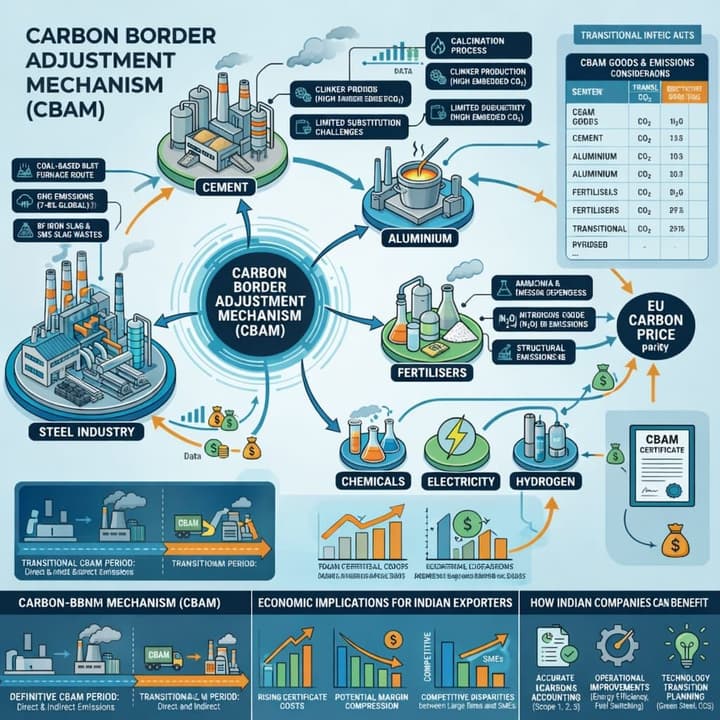
CBAM is not a Scope 3 regime, but it requires verified embedded-emissions data from suppliers of covered goods. The definitive period has run since 1 January 2026. There is a 50-tonne threshold per importer per year (electricity and hydrogen excluded), authorised declarant status is required, and certificates go on sale from February 2027. Read more in our CBAM readiness playbook.
One dataset, many requests. A supplier can face several of these at once: a listed Indian customer building BRSR value-chain data, an EU buyer reporting under CSRD, and a US customer preparing an SB 253 filing. One set of well-documented activity data can answer all of them. Supplying the same figures again in different formats costs more.
7. Checklist for your first Scope 3 emissions assessment
1. Screen everything first. Estimate all 15 categories roughly, and keep the total as the denominator for any later exclusion.
2. Tag data type and method on every line from the first run. Rebuilding that record later is slower than keeping it now.
3. Keep an exclusions register with category, reason, estimated share and the NA or X notation.
4. Spend effort where the share is. Move the largest Category 1 suppliers up the data hierarchy. Leave the long tail on average-data or spend-based lines, documented line by line.
5. Record how supplier data was allocated, and whether each supplier is homogeneous or diversified.
Fix the organisational boundary and GWP basis against the final text of each regime that applies. The revised ESRS and the GHG Protocol draft are both changing consolidation language, and the draft proposes removing the equity-share approach.
7. Decide early what will be verified. The draft labels would make partial verification visible to readers.
8. The limits of the Scope 3 number
The 2011 standard accepts higher uncertainty in Scope 3, as long as data quality suits the company’s goals. The draft states that data type is not, by itself, a measure of data quality or accuracy. A tiered disclosure shows what kind of data sits behind a figure, and leaves its accuracy open.
A change of method moves the number even when activity is flat. Switching a category from spend-based to supplier-specific data can shift the total, which is why the standard includes guidance on recalculating the base year.
Summing Scope 3 across companies counts the same tonne in several ledgers, because one firm’s Scope 3 is another’s Scope 1, 2 or 3. That is our reading of the category structure, and it applies to the India figures in section 2 as much as to anyone else’s.
Return to the paper clips. Their emissions sit in several ledgers: the stationery maker’s, the paper mill’s, the wire drawer’s, and the buyer’s Category 1. Each is counted once in its own book and invisible from every other. The rewrite asks each book to say how much of its content was measured and how much was estimated. If that disclosure arrives, a further question follows. Who will read across the books, link the tiers along a chain, and say which tonne belongs where?
Frequently asked questions about Scope 3 emissions
What are the 15 categories of Scope 3 emissions?
The GHG Protocol splits Scope 3 into 8 upstream categories (purchased goods and services, capital goods, fuel- and energy-related activities, upstream transport, waste, business travel, employee commuting, upstream leased assets) and 7 downstream categories (downstream transport, processing of sold products, use of sold products, end-of-life treatment, downstream leased assets, franchises, investments).
Is Scope 3 reporting mandatory in India?
Not yet. Under SEBI’s BRSR framework, Scope 3 is a voluntary Leadership Indicator. Value-chain disclosures are voluntary for the top 250 listed companies from FY 2025–26. Large customers in the EU and US are, however, increasingly asking Indian suppliers for the data.
What is the GHG Protocol’s proposed 95% rule?
Under the March 2026 draft, companies would have to report at least 95% of their required Scope 3 emissions. They would still have to quantify the excluded 5% every year to prove it stays under the threshold. The proposal is a draft and may change before the new standard is published, which is expected in 2028.
Start your Scope 3 emissions assessment with Ploxi
A first Scope 3 emissions assessment does not need perfect data. It needs a defensible screen of all 15 categories, a clear exclusions register and a plan to improve the data where it matters most.
• Get a first estimate with the free GHG Calculator on Ploxi Earth.
• Build an inventory that holds up: Ploxi Consult supports GHG inventories and audits, supplier data programmes, and BRSR, CSRD and SBTi alignment. Email contact@ploxiconsult.com to discuss your Scope 3 assessment.
Turning the inventory into a reduction plan comes next. See Decarbonisation roadmap development.
Sources
• GHG Protocol, Scope 3 Standard Revisions: Phase 1 Progress Update (31 March 2026).
• GHG Protocol, Corporate Standard Development Plan v2.0 (29 July 2026).
• GHG Protocol, Technical Guidance for Calculating Scope 3 Emissions, Chapter 1.
• CDP, Supply chain report press release (25 June 2024). Source of the 26× and 15% findings.
• SBTi, Corporate Net-Zero Standard v1.3.1.
• SBTi, Transition guide to Corporate Net-Zero Standard v2.0 (11 June 2026).
• IFRS Foundation, ISSB issues targeted amendments to IFRS S2 (11 December 2025).
• European Union, Commission Delegated Regulation (EU) 2026/1563.
• IIM Bangalore, Business Responsibility and Sustainability in India, FY 2024–25. Analysis of 982 companies with valid filings across 22 sectors.
• Securities and Exchange Board of India (SEBI), circular of 28 March 2025 on BRSR Core and value-chain disclosures.