CBAM and CCTS Readiness: A Price With Nothing to Buy, and a Market With No Trades
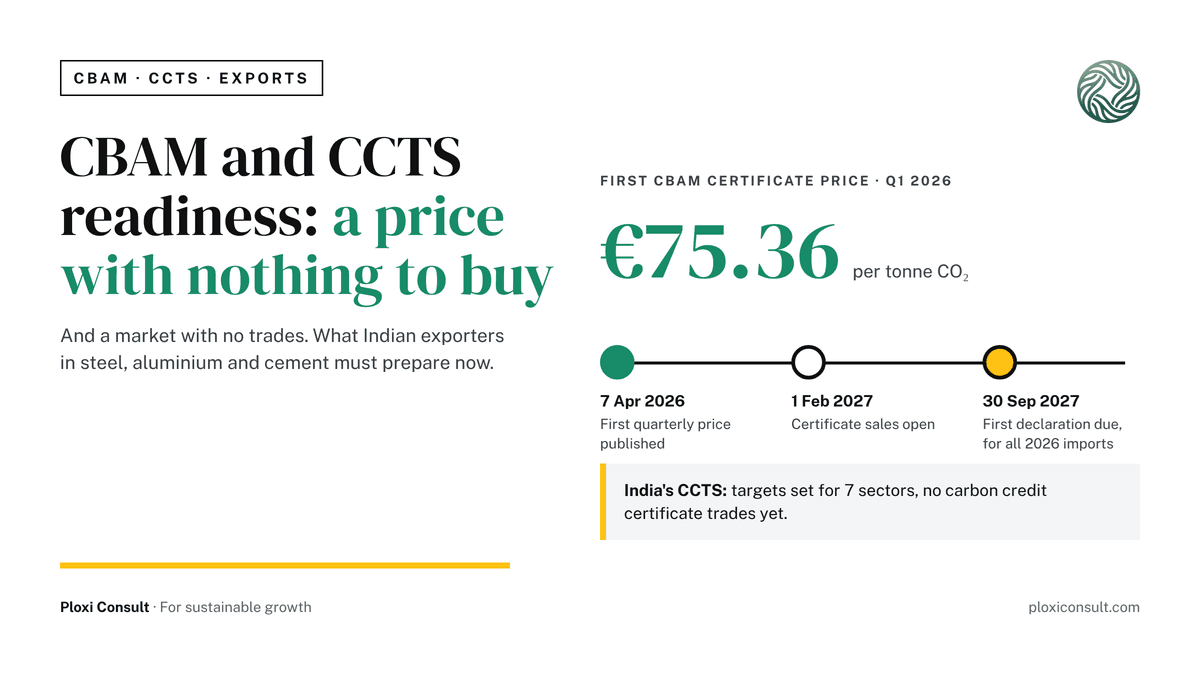
On 7 April 2026 the European Commission published the first quarterly CBAM certificate price: €75.36 per tonne of CO2, for goods imported in the first quarter. The second quarter followed on 6 July at €75.28. Nobody could buy a certificate with either number. Sales open on 1 February 2027, and the first declaration, covering all 2026 imports, falls due on 30 September 2027. For a year, the EU priced carbon on goods that had already crossed the border and left the bill for later.
India's side of the story runs the other way: a domestic market whose targets are set and whose first trades are still awaited.
CBAM in its definitive phase
Scope. Iron and steel, aluminium, cement, fertilisers, electricity and hydrogen. For steel and aluminium only direct (Scope 1) emissions count; for cement and fertilisers, direct and indirect.
Who pays. The EU importer, as an authorised CBAM declarant. An Indian exporter pays nothing to Brussels directly and supplies the data its buyer needs. The commercial pressure travels back through price and contract terms.
The 50-tonne threshold. The Omnibus Regulation (EU) 2025/2083, in force from 20 October 2025, replaced the old €150 per-consignment exemption. An importer bringing in no more than 50 tonnes of net mass per calendar year across cement, iron and steel, fertilisers and aluminium is exempt. It does not apply to electricity or hydrogen. Once an importer crosses 50 tonnes, obligations apply.
Actual or default. Declarants now choose freely between verified actual emissions and the Commission's country- and product-specific default values. Defaults carry a mark-up: 10 per cent in 2026, 20 per cent in 2027 and 30 per cent from 2028 for most goods, with fertilisers at 1 per cent for now and a review due by the end of 2027. At the Q1 2026 price, each 10 per cent of mark-up adds about €7.54 per tonne of default-value emissions, and 30 per cent adds about €22.61.
Corrected defaults. The defaults in Implementing Regulation (EU) 2025/2621 were corrected by Implementing Regulation (EU) 2026/1740, published on 31 July 2026 and applying retroactively from 1 January 2026. Any exposure estimate built on earlier default tables needs a rerun.
Money and dates. The 2026 certificate price is a quarterly average of EU ETS auction prices, switching to a weekly average from 2027. Quarterly holding rises to at least 50 per cent of embedded emissions from 2027. Free allocation under the EU ETS phases out between 2026 and 2034, and CBAM obligations scale up with it.
Guidance for non-EU producers. In August 2026 the Commission published ten guidance documents for installation operators outside the EU. They are the best starting reading list for an Indian plant.
Next in line. In December 2025 the Commission proposed extending CBAM from 2028 to 180 downstream steel- and aluminium-intensive products, including items such as power transformers, cables and farm machinery. The Council's position adds some 200 more metal-intensive goods. This is still in the legislative process.
What it looks like from India
The EU is India's third-largest trading partner, with goods trade of €118 billion in 2025. ORF reports that iron and steel account for 60 per cent or more of India's CBAM-embedded exposure. The India–EU free trade agreement, signed on 27 January 2026, gave India no concession on CBAM, according to Business Standard. Department of Commerce data show iron and steel exports to the EU down 13 per cent in the four months to April 2026. ICRIER's June 2026 model projects a 24 per cent fall in steel exports. Treat the 24 per cent as a modelled scenario and the 13 per cent as an early observation.
CCTS: targets set, trading awaited
Design. India's Carbon Credit Trading Scheme (notified June 2023) is an intensity-based baseline-and-credit system. Plants that beat their tCO2e-per-tonne target earn Carbon Credit Certificates from BEE; plants that miss must buy and surrender them. Banking is unlimited, borrowing and offsets are not allowed, and the penalty is an environmental compensation of twice the average CCC price.
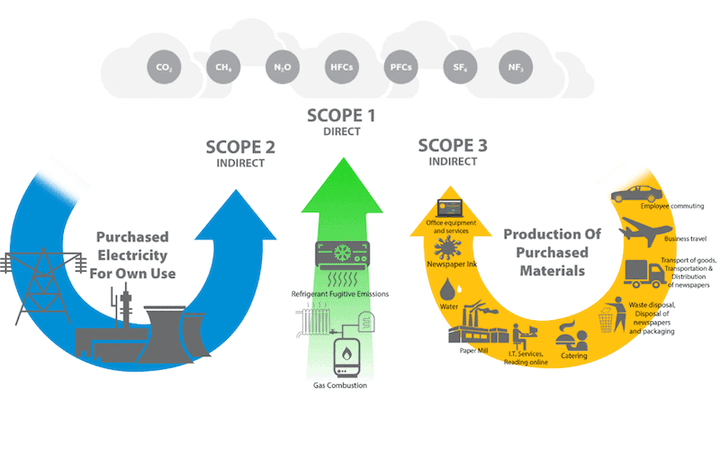
Boundary. Gate-to-gate, covering Scope 1 and 2 plus some Scope 3 for traded intermediates, and initially only CO2 and perfluorocarbons.
Sectors and dates. Targets for aluminium, cement, chlor-alkali, and pulp and paper were notified on 8 October 2025 (282 plants), and for petroleum refining, petrochemicals and textiles on 16 January 2026. That makes seven sectors and about 490 units, on an FY 2023-24 baseline, for FY 2025-26 and FY 2026-27. Reports go to BEE, verified by a BEE-accredited agency, within four months of the year's end (31 July). Iron and steel has a revised draft only: published on 26 June 2026 for 255 units with a 60-day comment window, averaging a 5.82 per cent intensity cut by FY 2026-27 according to CSE. Reports up to mid-November 2026 show no final notification. Fertiliser has no notified targets either.
Reduction levels. ICAP lists the average reduction through FY 2026-27: integrated cement 2.7 per cent, aluminium 4.9 per cent, cement grinding 6.6 per cent, chlor-alkali 6.5 per cent, petrochemicals 3.6 per cent.
Trading. CERC notified its CCC trading regulations on 27 February 2026. Certificates trade only on CERC-registered power exchanges (IEX, PXIL and HPX), within a floor price and a forbearance price that CERC approves on BEE's proposal. Official statements pointed to first trades around October 2026. The most recent reports I found, from mid-November 2026, record no trade, so no market price exists yet.
Where the two regimes meet
They overlap today in two sectors, aluminium and cement, and will overlap in steel and fertilisers once those targets finalise. They count differently. CBAM measures embedded emissions of specific products under EU rules, and CCTS measures a facility's intensity under Indian rules with a narrower gas list. Same plant, same meters, two boundaries. A CCC is also not a CBAM certificate: ICAP records that the CCTS is not linked to any other system. The EU rules allow a deduction for a carbon price actually paid in the country of production, certified and net of rebates. I found no source that settles whether, or how, a CCC purchase would qualify under the EU rules. The UK has answered its side: HM Treasury has placed India's CCTS on the indicative list of overseas carbon pricing schemes eligible for carbon price relief under the UK CBAM, which takes effect on 1 January 2027. Relief depends on the effective carbon price actually paid and on verification paperwork, and the CCTS has not yet produced a price.
What a Ploxi readiness assessment covers
Exposure screen: which products reach the EU or the UK, and whether the buyer is an authorised declarant.
Installation data audit (Ploxi's energy, waste and air audits): fuel, power and process data at the metering level that CBAM and CCTS both draw on.
Two numbers from one dataset: product-level embedded emissions under the CBAM method, and facility-level intensity under the CCTS method.
Verification readiness: whether the data would survive an accredited CBAM verifier or a BEE-accredited CCTS agency.
Cost scenarios for finance teams and lenders (climate finance structuring): default-value exposure at the 10, 20 and 30 per cent mark-ups on the corrected tables, and CCC cost or revenue ranges once a price exists.
Supplier data: coal, power and purchased intermediates, since many suppliers have never measured their own emissions.
Indian plants in overlapping sectors will soon be audited twice for the same tonne, by regimes that agree on the chemistry and disagree on the boundary.