As a Sustainability Analyst deeply embedded in the ESG field for over two decades, I've seen the industry mature from nascent aspirations to a critical pillar of global finance and corporate strategy. A cornerstone of this evolution is the increasing demand for high-quality, comparable, and actionable ESG data. But in a landscape often described as the "Wild West" of data, how do we achieve this? The answer lies in the growing importance of ESG data standards, taxonomies, and the transformative power of Open APIs.
This blog post will demystify these crucial concepts, highlight the leading frameworks, and explain how leveraging Open APIs is becoming non-negotiable for companies and investors aiming for true sustainability integration and transparent disclosure.
Why Standardized ESG Data Matters: Beyond Greenwashing
In the early days of ESG, companies could largely pick and choose what to report, leading to inconsistent disclosures and making it incredibly difficult for investors to compare performance or assess genuine sustainability impact. This lack of standardization fueled concerns about "greenwashing" – companies overstating their environmental or social credentials.
Standardized ESG data addresses these critical issues by:
- Enhancing Comparability: Allowing investors and stakeholders to directly compare the ESG performance of different companies, even across sectors, based on consistent metrics.
- Improving Reliability and Verifiability: Providing clear methodologies for data collection and reporting, leading to more accurate and auditable information.
- Reducing Greenwashing Risk: Establishing clear criteria and metrics that make it harder for companies to mislead stakeholders about their sustainability efforts.
- Facilitating Informed Decision-Making: Equipping investors with the granular data they need to integrate ESG factors into their financial analysis, risk management, and capital allocation.
- Driving Corporate Accountability: Holding companies accountable for their environmental and social impacts and encouraging continuous improvement.
The Language of Sustainability: Key ESG Taxonomies & Frameworks
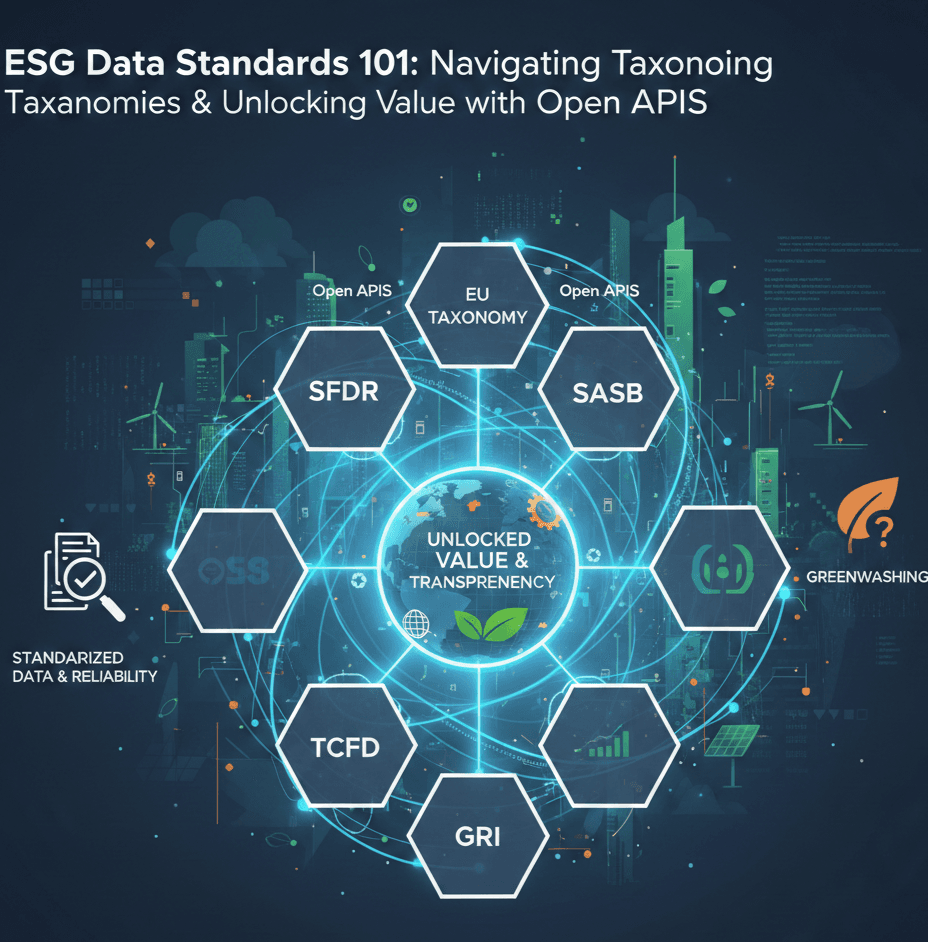
To standardize data, the market has developed various frameworks and taxonomies, each serving a slightly different purpose but collectively working towards a more cohesive ESG reporting landscape.
The EU Taxonomy: Defining "Green" Economic Activities
- Purpose: The EU Taxonomy is a classification system that establishes a comprehensive list of environmentally sustainable economic activities. It's a cornerstone of the EU's Sustainable Finance Action Plan, designed to channel investments towards truly green activities.
- Scope: It defines criteria for activities that make a "substantial contribution" to at least one of six environmental objectives (e.g., climate change mitigation, pollution prevention) while doing "no significant harm" (DNSH) to the others, and adhering to minimum social safeguards.
- Impact: It provides a common language for investors and companies in the EU to understand what qualifies as sustainable, significantly impacting financial product labeling (e.g., SFDR) and corporate reporting.
SFDR (Sustainable Finance Disclosure Regulation): Investor Transparency
- Purpose: SFDR aims to increase transparency around sustainability claims of financial products and financial market participants (FMPs) in the EU. It combats greenwashing by classifying financial products based on their sustainability ambition.
- Classification: Products are categorized into:
- Article 6: Products not promoting ESG characteristics.
- Article 8 ("light green"): Products promoting environmental or social characteristics.
- Article 9 ("dark green"): Products with sustainable investment as their objective.
- Impact: SFDR mandates detailed disclosures from FMPs on how they integrate sustainability risks and consider adverse sustainability impacts at both entity and product levels, driving demand for granular, verifiable ESG data.
SASB (Sustainability Accounting Standards Board): Industry-Specific Materiality
- Purpose: SASB Standards identify financially material sustainability issues for 77 industries. They are designed to help companies disclose sustainability-related risks and opportunities that could reasonably be expected to affect their financial performance or capital.
- Focus: SASB emphasizes financial materiality – information that is relevant to investors' decision-making. It provides specific metrics and reporting guidelines tailored to the unique impacts of each industry.
- Impact: Widely adopted by companies and favored by investors seeking financially relevant ESG data, SASB Standards are now overseen by the International Sustainability Standards Board (ISSB), aiming for a global baseline in sustainability disclosures.
TCFD (Task Force on Climate-related Financial Disclosures): Climate Risk Reporting
- Purpose: The TCFD developed recommendations for climate-related financial disclosures to help companies and financial institutions provide investors with better information about their climate-related risks and opportunities.
- Framework: Its recommendations are structured around four core pillars: Governance, Strategy, Risk Management, and Metrics & Targets. A key aspect is scenario analysis to assess resilience to different climate futures (e.g., a 2°C scenario).
- Impact: TCFD has become a globally recognized framework, increasingly mandated or encouraged by regulators worldwide, driving significant improvements in climate risk reporting and integrating it into mainstream financial filings.
GRI (Global Reporting Initiative): Comprehensive Stakeholder Reporting
- Purpose: GRI Standards are the world's most widely adopted sustainability reporting standards, designed to help organizations understand and communicate their impacts on the economy, environment, and society.
- Focus: GRI takes a multi-stakeholder approach, aiming to inform a broad range of users about a company's most significant impacts. It covers a wide array of topics from emissions and water use to human rights and labor practices.
- Impact: GRI provides a robust framework for comprehensive sustainability reporting, enabling organizations to report on their material topics in a structured and comparable manner.
The Revolution of Open APIs: Unlocking ESG Data Flow
While taxonomies provide the "what" and "how" of ESG reporting, Open APIs (Application Programming Interfaces) are the "how to get it there" – the technological backbone enabling seamless and automated exchange of this complex data.
An API is essentially a set of rules and protocols that allows different software applications to communicate with each other. When an API is "open," it means it's publicly available, enabling external developers to access and integrate with a system's functionalities or data.
How Open APIs Transform ESG Data Management:
- Automated Data Collection & Integration: Instead of manual data entry or cumbersome spreadsheet transfers, APIs allow companies to directly pull ESG data from various internal systems (e.g., energy meters, HR databases, supply chain platforms) and external sources (e.g., ESG ratings providers, satellite data) into a centralized platform.
- Real-time Monitoring: Companies can continuously monitor their ESG performance, tracking metrics like energy consumption, emissions, and waste generation in near real-time. This enables proactive management and quicker responses to deviations from sustainability targets.
- Streamlined Reporting: APIs facilitate automated report generation, feeding standardized ESG data directly into reporting tools. This significantly reduces manual effort, minimizes errors, and helps companies meet stringent regulatory deadlines (e.g., for CSRD, SFDR, or local mandates).
- Enhanced Data Quality & Validation: By automating data flows, APIs can incorporate validation rules and flag inconsistencies, improving the accuracy and reliability of ESG data. AI-driven APIs can even detect anomalies, reducing greenwashing risks.
- Improved Interoperability: As discussed, the ESG reporting landscape is fragmented. Open APIs are crucial for bridging these gaps, allowing different ESG platforms, databases, and analytical tools to "speak the same language" and exchange data seamlessly.
- Fostering Innovation: Open APIs empower third-party developers to build innovative ESG solutions, from advanced analytics dashboards and predictive risk models to specialized tools for supply chain transparency or carbon accounting. This creates a vibrant ecosystem of ESG technology.
- Better Investor Insights: For investors, Open APIs from data providers mean faster access to granular, standardized ESG data, enabling quicker integration into portfolio analysis, risk assessment, and investment decision-making processes.
Challenges and the Path Forward
Despite their immense potential, the journey towards fully standardized and API-driven ESG data is not without its hurdles:
- Data Fragmentation & Inconsistency: Even with standards, the sheer volume and variety of data sources, coupled with evolving methodologies, still pose challenges.
- Interoperability Gaps: While progress is being made (e.g., ISSB-ESRS mapping), ensuring seamless interoperability between all global and regional standards is an ongoing effort.
- Data Quality & Verification: The "garbage in, garbage out" principle still applies. Ensuring the underlying data is accurate, complete, and verifiable remains paramount.
- Security & Privacy: As more sensitive ESG data flows through APIs, robust cybersecurity measures and data privacy protocols are essential.
- Resource & Expertise: Implementing and managing complex ESG data systems, including API integrations, requires significant technical expertise and resources that many companies, especially SMEs, may lack.
However, the opportunities far outweigh the challenges. The push for global sustainability disclosures (e.g., IFRS S1 and S2 by ISSB) will further accelerate the need for robust data management and interoperability. Companies that proactively invest in understanding and implementing ESG data standards and leveraging Open APIs will gain a significant competitive advantage.
The Future is Interconnected and Transparent
In conclusion, ESG data standards and taxonomies are the blueprints for a sustainable future, providing the clarity and consistency desperately needed in the ESG landscape. Open APIs are the engines that power this future, enabling the efficient, accurate, and transparent flow of critical sustainability information.
For companies, the message is clear: embrace these standards, invest in the technology to manage and exchange your ESG data seamlessly, and prepare for a future where sustainability performance is as scrutinized and integrated as financial performance. For investors, demand standardized data accessible via robust APIs – it's the key to truly understanding impact, mitigating risks, and capitalizing on the opportunities of the green economy. The future of sustainable finance is interconnected, transparent, and built on a foundation of solid, standardized ESG data.